
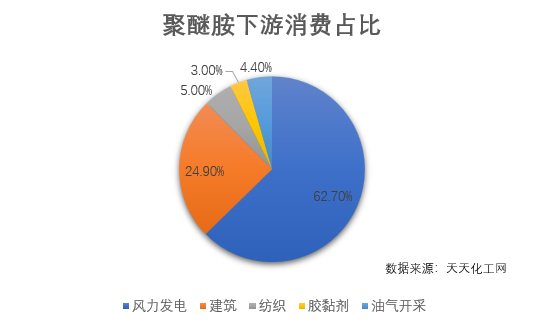
polyetheramine is a polymer of polyether and amine. since it was invented in the 1960s, its market application has gradually expanded, and it began to be applied on a large scale in the industrial field in the 1990s. because polyetheramine has the advantages of waterproof, anti-aging, high toughness and long service life. therefore, it is mainly used in construction and wind power generation in today’s industry. especially in the application of the most important blades in the wind power industry, because the blades themselves have a large size and a compact and complex structure, and in most cases the blades need to be used in long-term harsh environments, which has great impact on materials and processes. the requirements are extremely high and must be able to maintain high toughness and high strength. among them, polyetheramine as a nstream product of propylene oxide is indispensable. especially for megawatt-level wind power blades, only one product, polyetheramine, can meet the relevant quality and industrial requirements, and has become the first choice of curing agent for the wind power industry. at present, the application of polyetheramine in the domestic wind power industry has reached 62.7%, the construction industry has reached 24.9%, and the total of the two has reached 87.6%.
up to now, there are only 7 major suppliers of polyetheramine in the world among them, and have the highest production capacity, accounting for 43% and 21% respectively, and the remaining five manufacturers are all in china, accounting for 36% of the global production capacity. the global polyetheramine production capacity currently totals about 280,500 tons. among them, there are only three domestic manufacturers that have exceeded the production capacity of 10,000 tons, namely akeli with 20,000 tons, chenhua with 31,000 tons, and chia tai new materials with 35,000 tons. therefore, in terms of supply, the polyetheramine market is currently dominated by foreign giants. due to insufficient domestic production capacity, and there is still a certain gap between domestic manufacturers and highly monopolized foreign oligarchs in terms of product models and production efficiency, polyetheramine is temporarily still in production. import substitution cannot be achieved. in contrast, under the influence of the policy of the “14th five-year plan” modern energy system plan for the wind power industry, china’s newly installed wind power capacity will reach more than 55gw in the second half of the year. in the next five years, the demand for polyetheramine in china’s wind power industry will increase to 61,000 tons.
in recent years, affected by the global new crown epidemic, and , etc. the overseas production capacity of mainstream international manufacturers is limited, the cost of logistics and sea transportation remains high, and the global supply chain cannot operate normally. affected by the loss of balance between supply and demand, overseas mainstream manufacturers have raised their prices several times, with the maximum amount of increase reaching 5,000 yuan/ton. the superposition of these factors has also won the opportunity for domestic polyetheramine manufacturers to catch up against the trend. at present, domestic polyetheramine manufacturers have begun to accelerate their production capacity expansion plans. for example, chenhua has planned an annual production capacity of 40,000 tons and is expected to be officially put into operation by the end of 2023. white”>chia tai new material plans to produce 20,000 tons and 10,000 tons respectively it is also expected to be officially put into production in 2023. far the long-term plan is like ’s announcement on its official website of the environmental report draft of the 40,000-ton polyetheramine project. the information shows that the project will build a 40,000-ton/year industrialized polyetheramine plant, which is absolutely cost-competitive. polyetheramine production line.
it is estimated that in 2025, china’s domestic polyetheramine will reach 170,000 from the perspective of market demand, the global market demand for polyetheramine will reach 138,000 tons in 2025. it can also be seen that in the future, local polyetheramine companies will be able to fully replace overseas manufacturers to meet domestic rigid demand and participate in the competition in the global polyetheramine market.