
recently, many manufacturers in northwest and south china have started annual maintenance or replacement of catalysts,bdo (1,4-butanediol) and its nstream industrial chain production are hindered, and the market supply side is strengthened. as of press time today, the operating rate of bdo manufacturers across the country has remained at about 57%, and it is expected to drop to about 42% by mid-september. although each manufacturer will prepare market reserves in advance before maintenance, due to the staggered time of equipment maintenance and the large proportion of maintenance of major manufacturers, the market supply will still show a nward trend, and the supply side will show an upward trend due to the short supply of the market.
as of augustaugust on the 29th, the dynamic status of the devices produced by bdo, a major domestic manufacturer, was updated as follows.
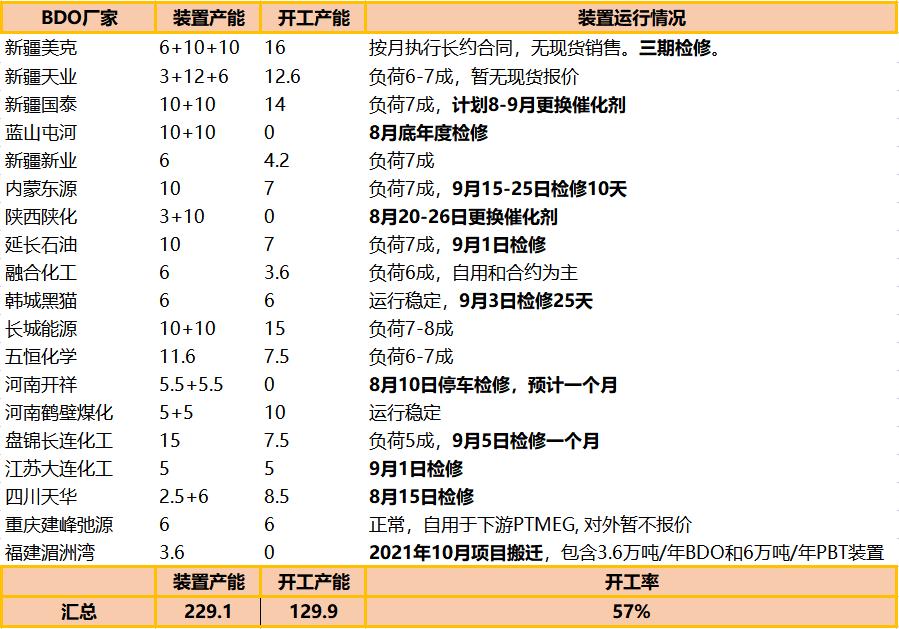
the main manufacturers in northwest china are xinjiang cathay pacific, xinjiang lanshan tunhe, xinjiang markothe overhaul was implemented in august, which led to the operating rate of bdo in northwest china dropped to about 30%. inner mongolia dongyuan also entered the maintenance cycle in the middle of this month. shaanxi shanhua, yanchang petroleum, and hancheng black cat, located in shaanxi, have successively entered the maintenance period since last month, and the maintenance is expected to be completed by the end of september. the operating rate in shaanxi also fell to about 30% during the factory maintenance phase. the operating rate in henan fell to 50%, which is higher than other regions. however, since manufacturers in henan have not disclosed any information on maintenance, the overall operating rate of bdo manufacturers across the country has remained at around 57% as of today’s press date. it is expected that by mid-september, the operating rate of manufacturers will further drop to 40%. the load continues to slump.

figure1
figure 1 summarizes the market price trend of bdo in the last quarter. in june, the price of bdo showed a steady nward trend, and the price range was maintained at 22,500-21,050 yuan/ton. at the end of the month, the price showed an obvious nward trend and continued until the beginning of august. the price fell below 20,000 yuan per ton and dropped to 9,900 yuan per ton. from mid-august to today’s press release, the price trend of bdo continued to slow n at a low level, hovering at the price of 9800 yuan / ton. it can be judged from the price changes that before the maintenance of the equipment of various manufacturers in august, the market supply was sufficient, and the overall supply of bdo was weak due to oversupply. beginning in august, about 40% of the manufacturers across the country have entered into maintenance, but because manufacturers have sufficient reserves before the maintenance, the impact on the rebound of market prices from low levels is not obvious. the price trend after august has been in a low sliding stage. starting from september, a number of manufacturers will be put into maintenance one after another, and some manufacturers will restart their installations. it is expected that the market price of bdo will continue to slide at a low level due to the shutn of many manufacturers at that time, and there will be a wave of rebound in october. the overhaul of manufacturers’ devices will not lead to the rigidity of the market. instead, there will be a wave of catalytic reactions due to intermittent production shutns. when the market demand exceeds supply, prices will rise. however, due to the recent complex international geopolitical situation, repeated domestic epidemics and the fed’s continuous interest rate hikes in response to severe domestic inflation, domestic bdo terminal nstream market demand has been weak, so the sharp rebound in bdo prices after september will not have too much impact optimistic influence.
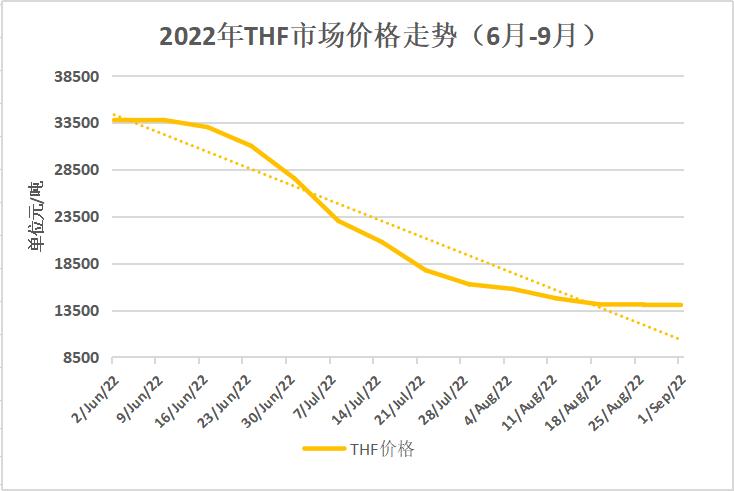
figure2
the decline in bdo operating rate will also affect other nstream products. thf (tetrahydrofuran) and ptmeg (polytetrahydrofuran) are the main nstream products of bdo as raw material, whilethf yesbdo is the largest nstream product of raw material polyester equipment, about80%thffor productionptmeg. figure 2 is the market price chart of thf from june to september this year. it can be seen that during the period when the price of bdo continued to fall steadily, the price of thf also showed a nward trend. compared with bdo, the price of thf fell more obviously, and the slope generated by the dotted line was also larger. tetrahydrofuran, which uses bdo as raw material, is mainly used in the takeaway industry after adding a stabilizer. since the production of thf requires a large amount of bdo, the price is generally higher than its raw material. therefore, the trend of price decline is directly proportional to the proportion of bdo consumed in production.
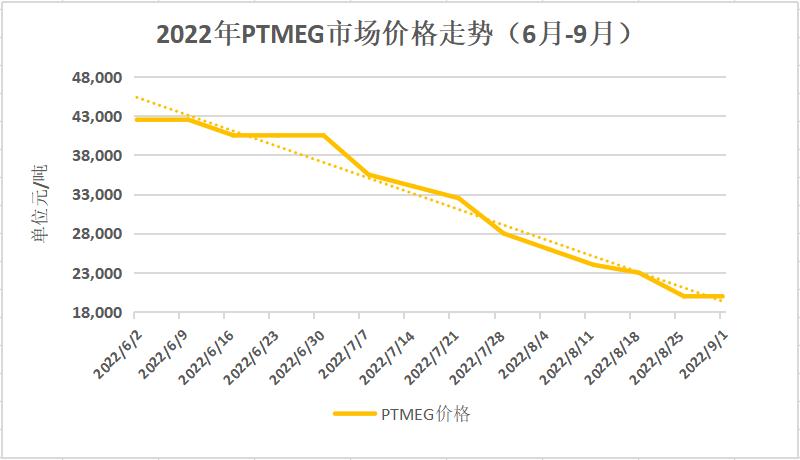
figure3
another nstream productthe price trend of ptmeg is also accompanied by bdo and thf the decline showed a stable positive correlation nward trend. since ptmeg is produced by thf polymerization, decolorization and transesterification, the same unit of thf can produce 80% of ptmeg. therefore, the market price change of ptmeg is greatly affected by the upstream raw material thf. from figure 3, it can be seen that under the trend of overall price decline from june to september, the price of ptmeg, like thf, rebounded slightly at the end of june. a steady nward trend began at the end of august.
in summary, we can see that,august-september staggered bdo equipment maintenance has a positive correlation with its nstream thf and ptmeg prices. due to the long-term weakness of the terminal market of bdo and the abundant reserves in the manufacturer’s maintenance market, the price continued to decline steadily and leveled off. the rising trend of the supply side caused by equipment maintenance has not been clearly reflected at the beginning of this month, and the boost of its market price is also offset by the weak demand in the terminal nstream market. in the same way, it can be seen that the prices of nstream thf and ptmeg are also affected by the same bulk factors, and the price fluctuations are directly proportional to each other.