
recently, the excellent innovation and entrepreneurship team from changzhou university – “straw membrane fan” innovation and entrepreneurship team won new large contracts and orders. the team signed a technical cooperation contract with well-known companies such as sinopec, and the company provided a total of 3.2 million yuan of funds to support the team’s scientific research. at the same time, an intentional order worth 4.9 million yuan was reached.
in agricultural production, plastic film plays a very important role. the use of mulch can increase soil temperature, retain moisture, prevent pests, and help increase crop production and income. the “straw membrane fan” team used straw as raw material to develop a variety of degradable plastic films to help the recycling of agricultural resources and increase farmers’ income.
“our team has 15 members, most of whom are from rural areas. we are very clear about how farmers worry about dealing with straw and plastic film remaining in the field.” ma binghao, a member of the team and a student at the school of materials science and engineering, changzhou university according to the introduction, it is difficult to remove and dispose of straw, and incineration will cause environmental pollution; most of the traditional mulch films are polyethylene products, which are difficult to degrade when left in the soil. “whether we can kill two birds with one stone and solve two major problems in one fell swoop has become the direction of our efforts.” ma binghao said.
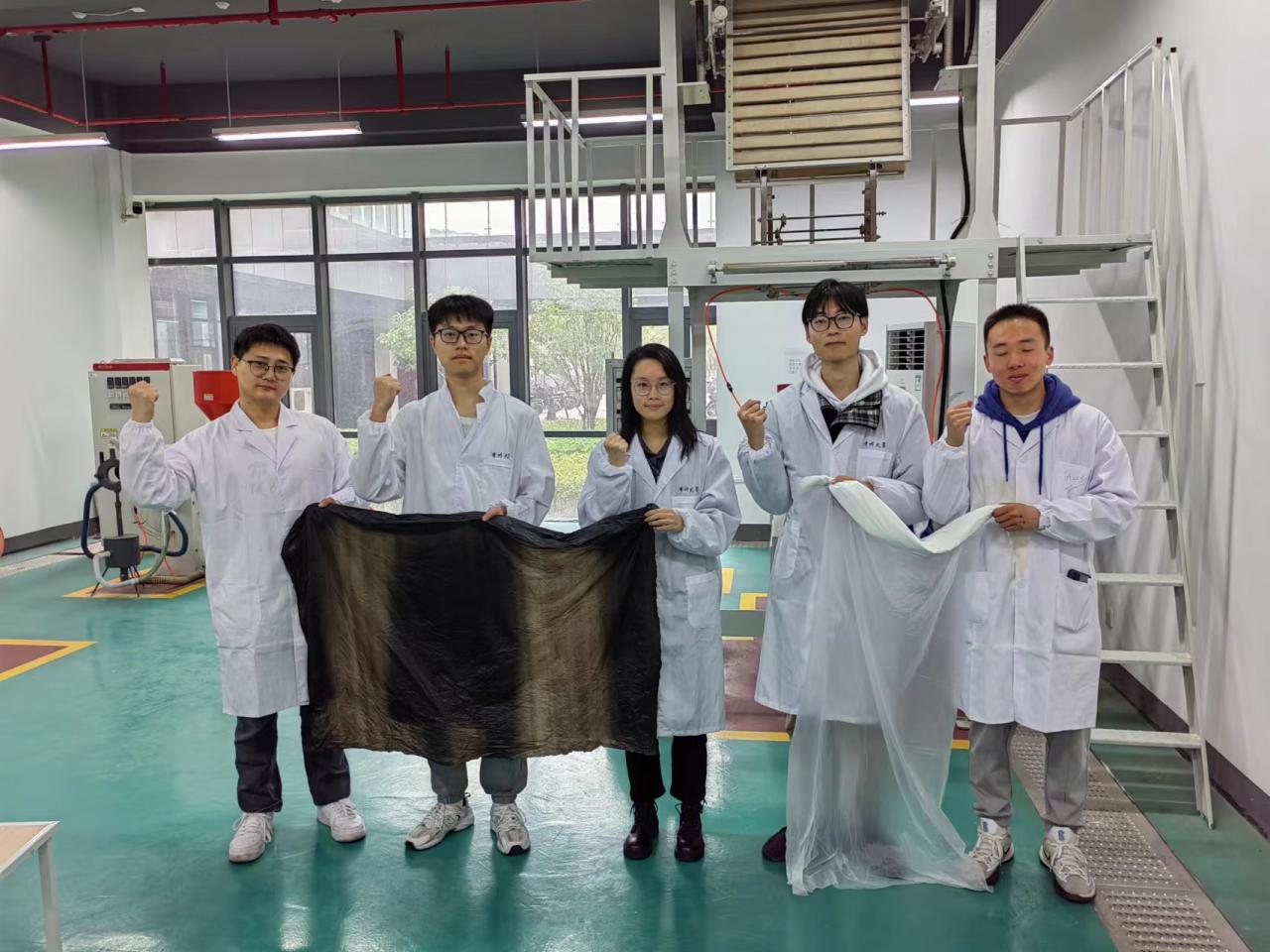
some team members show products
in 2018, under the leadership of li ning, the instructor and deputy director of the analysis and testing center of the school of materials science and engineering, changzhou university, the “straw membrane model” team was formally established. relying on the school’s scientific research results and laboratory resources in polymer materials, the team began to tackle the technology of “preparing biomass polyurethane from straw, and then preparing degradable plastic film from polyurethane”.
“first, lignin polyols are extracted from straw, and then synthesized and converted into polyurethane. this is a high-molecular polymer, and we process it into a degradable mulch.” li ning introduced that the straw made of the mulch can be degraded naturally, which solves the two “persistent” problems of farmers at once. the degradation cycle of the mulch film can also be adjusted through the formula of polyurethane raw materials. according to the climate environment and soil characteristics of different farmlands, the degradation cycle is 6 months to 1 year.
the breathable defrosting vegetable film and the high-transmittance thermal insulation cotton field film are the two major products of the “straw film fan” team. ma binghao introduced that the breathable defrosting vegetable film has good air permeability, strong moisture retention and heat preservation, and is suitable for the rainy and humid south. “the high-transmittance thermal insulation cotton field film is very popular in the northwest. it has good light transmission, high strength, and strong tear resistance. it is very suitable for cotton fields in xinjiang, which require a lot of light but are windy and sandy.” team member ai yuchen is from xinjiang, and she has been trying to expand her hometown market. “when we first promoted this mulch film, many villagers in xinjiang did not believe it. i asked my relatives to try it first, and everyone found that the effect was really good. not only did they use it themselves, but they also spontaneously became our ‘promotion ambassadors’.” ai yuchen said with a smile.
green water and green mountains are mountains of gold and silver. in the future, the “straw membrane fan” team will continue to deepen the research and development of technology, develop a mulch film with a wider application range and stronger reproducibility, promote the development of green and low-carbon cycles, open up a new path for “double carbon”, and contribute to agricultural development and rural revitalization contributes youth power.